We’ve all been there. You’re tinkering with a new large language model—maybe it's Claude, maybe it's one of OpenAI’s wizards—and you ask it to write a script. It spits out some code. Looks good. Then you ask it to run the code. And for a split second, a cold sweat runs down your back. What if it suggests `rm -rf /`? Or tries to install some obscure, malicious package? It's a tiny moment of tech-induced panic.
For years, we've treated our development environments with a certain reverence. We curate them, we protect them. Now, we're inviting these incredibly powerful, slightly unpredictable AI agents right into our digital homes. It feels a bit like giving a brilliant but chaotic intern the root password. Exciting, but terrifying.
This is the exact headache I've been wrestling with, and it's why I got so genuinely excited when I stumbled upon VibeKit. It’s not just another tool; it feels like a necessary piece of the puzzle for the future of AI-assisted development.
So, What Is This VibeKit Thing Anyway?
At its heart, VibeKit is an open-source Software Development Kit (SDK). But that’s a dry way of putting it. Think of it more like a universal translator and high-security containment cell for AI coding agents. It gives you a simple way to let models like Claude, Codex, and Gemini run code, install packages, or even open pull requests, but all within a secure, isolated sandbox.
You get all the power of the AI, without the risk of it accidentally (or not-so-accidentally) messing up your local machine or, heaven forbid, your production server. It’s built with TypeScript and is MIT licensed, which for developers like us means one beautiful thing: no vendor lock-in. You can use it, change it, and build on it without owing anyone a dime. That’s a philosophy I can always get behind.
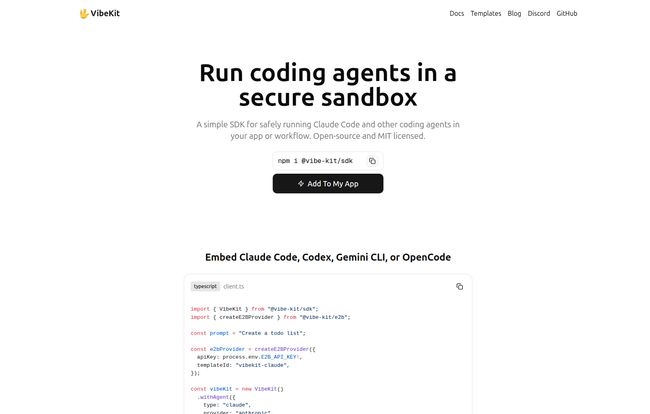
Visit VibeKit
Why Sandboxing Your AI Is No Longer Optional
In the early days of messing with LLMs, running their output directly was a fun party trick. Now that we're building real applications and internal tools with these agents, that approach is just not sustainable. It's professional malpractice, waiting to happen.
The Wild West of AI-Generated Code
Let's be honest, LLMs are incredible, but they don't understand code in the way we do. They are masters of pattern recognition. This means they can sometimes generate code that has subtle vulnerabilities or calls deprecated libraries. Letting that code run with full permissions is like playing Russian roulette with your system's integrity. It’s not a matter of if something will go wrong, but when.
VibeKit as Your Digital Quarantine Zone
This is where the sandbox concept becomes so critical. A sandbox is an isolated testing environment. Nothing that happens inside it can affect the host system. VibeKit makes creating and managing these sandboxes almost trivial. It’s like giving your AI agent its own little apartment with padded walls. It can go nuts, try things, break things, and at the end of the day, you can just wipe the slate clean without any damage to your actual house. This freedom to experiment safely is, for me, its most powerful feature.
The Core Features That Get Me Excited
I’ve seen a lot of dev tools come and go, but VibeKit has a few features that really make it feel well-thought-out and built by people who actually code for a living.
Truly Open-Source and Flexible
I mentioned the MIT license, but it's worth repeating. This isn't 'open core' or some other marketing gimmick. It's genuinely open. You can see the code on their GitHub. More than that, it's designed for flexibility. It supports multiple sandbox providers right out of the box—like E2B, Daytona, Modal, and Fly.io—with more on the way. This means you can choose the backend that fits your security and performance needs, rather than being stuck with one company's ecosystem.
Seamless Integration and Streaming
One of the coolest parts is the built-in support for streaming. If you’re building a UI where the user can see the AI working, you can stream the agent’s output directly to the screen. It creates a much more interactive and responsive user experience, instead of just showing a loading spinner for thirty seconds. It’s a small detail that makes a huge difference in how an application feels.
Connect Directly to Your Codebase
This is huge. VibeKit has GitHub integration. You can point the agent at a repository, and it can work on the actual codebase. Imagine an AI agent that can check out a branch, write new code, and then create a pull request for a human to review. That's not science fiction; that's a feature here. It transforms the agent from a simple code generator into a genuine collaborator.
Practical Use Cases for VibeKit
So, this all sounds great, but what would you actually build with it? The possibilities are pretty broad, but here are a few ideas that immediately spring to mind.
- Smarter Internal Tools: Build a custom Slack bot that can securely run diagnostics on a staging server or help new developers get their environment set up.
- AI-Powered App Features: Add a feature to your SaaS product where users can describe what they want in plain English, and the AI scaffolds the code, generates API calls, or configures a dashboard for them.
- Rapid, Safe Prototyping: Want to test out a new library or framework without polluting your local machine? Just spin up a sandboxed agent with VibeKit and tell it to install and configure everything. It's a disposable, safe environment for exploration.
- Automated Debugging: Create a CI/CD pipeline step where an AI agent attempts to debug failed tests. It could analyze the error logs, suggest a fix, and create a PR, all automatically. That's the dream, right?
Getting Started with VibeKit (and How Much It Costs)
This is the best part. Getting started is as simple as running an npm command:
npm i @vibekit/sdk
And the price? Well, the VibeKit SDK itself is free. F-R-E-E. It’s open-source, remember? Your only costs would be associated with the LLM you choose to use (your OpenAI/Anthropic API bill) and the sandbox provider you run it on, some of which also have generous free tiers. There's no VibeKit subscription, no per-seat licensing, no funny business. It’s just a solid, free tool for the community.
Frequently Asked Questions about VibeKit
- Is VibeKit really free to use?
- Yes, the VibeKit SDK is 100% free and open-source under the MIT license. You'll only have to cover the costs for the AI model API (like OpenAI) and the sandbox infrastructure provider (like E2B or Daytona) you decide to use.
- What language is VibeKit built with?
- It's built with TypeScript, making it a natural fit for the modern JavaScript/Node.js ecosystem. This also means great type support and integration with many popular frameworks.
- Can I use VibeKit with my own custom LLM?
- The design is model-agnostic. While it has easy integrations for popular agents like Claude and Gemini, you can wire it up to work with any model that can generate code or commands. You just need to handle the interaction logic.
- Which sandbox providers are supported?
- Currently, it supports E2B, Daytona, Modal, and Fly.io. The team has mentioned that support for Cloudflare Workers, Deno, and Northflank is on the roadmap.
- How does VibeKit actually handle security?
- VibeKit itself is the orchestration layer. The actual security and isolation are handled by the underlying sandbox provider you choose. These providers specialize in creating secure, firewalled environments where code can execute without any access to the host system or network, unless explicitly permitted.
My Final Take
Look, the AI wave isn't just coming, it’s already here. The tools that will win are the ones that empower developers to harness this power safely and flexibly. VibeKit feels like one of those tools. It’s not a complete, all-in-one platform that locks you in. It’s a sharp, well-designed SDK that does one thing exceptionally well: it provides a secure bridge between AI agents and real-world code execution.
For any developer or team looking to build the next generation of AI-powered applications, this is a project you should be watching. Or better yet, contributing to. It’s a practical solution to a very real problem, and it's built with the right ethos—open, flexible, and developer-first. What more could you ask for?
Reference and Sources
- VibeKit Official GitHub Repository
- E2B - A supported sandbox provider
- Anthropic (Creators of Claude)
- OpenAI (Creators of Codex and GPT models)