The AI boom is exciting, no doubt about it. We're living in a sci-fi novel. But as someone who spends their days knee-deep in traffic analytics and server logs, I also see the other side: the cost. Not just the dollar cost, which is eye-watering enough, but the carbon cost. Training massive AI models can have a staggering environmental footprint. It's the big, inconvenient truth hiding behind all the slick demos.
So when a company pops up with "low-carbon footprint" and "#GreenAI" right on their homepage, my ears perk up. Enter GreenEyes.AI, a new-ish player in the computer vision space that’s trying to thread a very difficult needle: be powerful, be scalable, and be responsible. But can they pull it off? I decided to take a look.
Visit GreenEyes.AI
So, What's the Deal with GreenEyes.AI?
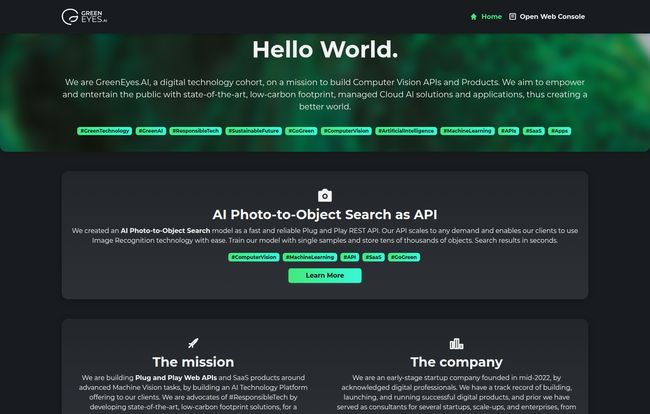
At its core, GreenEyes.AI is a digital technology company building tools that help computers see and understand the world. Think of it as a set of powerful building blocks for developers. Instead of spending years and a small fortune building their own image recognition tech from scratch, a developer can just plug into one of GreenEyes.AI's APIs.
They're a startup, founded in mid-2022 and hailing from Budapest, Hungary. You can feel that startup energy on their site—it’s lean, focused, and gets straight to the point. No fluff. Their mission is pretty clear: to provide advanced Machine Vision tools, like APIs and SaaS products, with a heavy emphasis on sustainability. They're championing what they call #ResponsibleTech. In an industry obsessed with moving fast and breaking things, this deliberate focus on not breaking the planet is, frankly, a breath of fresh air.
Breaking Down the Tech: What's in the Toolbox?
Okay, so they're all about being green. I love that. But the tech has to work, right? A low-carbon-footprint calculator is great, but it won't help my e-commerce client automatically tag 2 million product images. So what are they actually offering? It boils down to a few key services.
The AI Photo-to-Object Search API
This is their bread and butter. Imagine you have a photo of a living room, and you want to find every single product on your website that looks like the specific lamp in that photo. That’s what this does. It’s an AI that can search for objects from a picture. GreenEyes.AI claims it's fast and built on a REST API, which is music to any developer's ears. It means integration should be straightforward. No need to learn some bizarre, proprietary system. It’s the tech equivalent of getting a standard Phillips-head screwdriver instead of some weird, custom-shaped bolt.
Object Labelling as an API
If you've ever dealt with a massive, messy library of images, you know the pain. Is this a picture of a 'dog', a 'golden retriever', or 'fluffy-good-boy-001'? Object labelling brings order to that chaos. This API is designed to extract information and apply context to images at scale. For businesses dealing with user-generated content, digital asset management, or even scientific research, this is huge. It automates one of the most tedious, mind-numbing tasks in data management.
Diving a Bit Deeper: Content-Based Image Retrieval (CBIR)
This one sounds a little more academic, and that's because it is. On their site, they mention a research project centered around a "performant, scalable and reliable CBIR system." In simple terms, this is the next level of image search. Instead of searching by text tags ('red', 'car', 'sunset'), a CBIR system analyzes the actual content of the image—colors, textures, shapes, and the spatial relationship between them. They mention this is integrated with their own Data Explorer platform. This suggests they're not just offering simple tools but also building a more comprehensive ecosystem for serious data analysis. It’s a subtle hint at their long-term ambition.
The #GreenAI Promise: More Than Just a Hashtag?
This is the part that really interests me. I've been in meetings where the server costs for a new project were debated for hours, but the carbon cost wasn't even a footnote. GreenEyes.AI puts it front and center. A focus on a "low-carbon footprint" means they're likely optimizing their models for efficiency, not just raw power. This can mean smaller models, more efficient code, and choosing data centers powered by renewable energy.
"We are advocates of #ResponsibleTech by decreasing power consumption of Machine Learning solutions, for a sustainable future." - GreenEyes.AI
For a growing number of companies, especially in Europe, ESG (Environmental, Social, and Governance) goals are becoming serious business drivers. Being able to report that your tech stack includes partners actively working to reduce their environmental impact is a genuine competitive advantage. It's a smart business move, and honestly, it’s just the right thing to do.
A Realistic Look: The Good, The Bad, and The TBD
I'm an optimist, but I'm also a realist. No tool is perfect, especially one from a young company. So, let’s put on our critical glasses.
The biggest pro is their mission. The combination of easy-to-use 'Plug and Play' APIs with a strong ethical backbone is compelling. They also claim enterprise-grade security and a scalable platform, which are essential checks for any serious project. The promise of fast, reliable results is the baseline, and they seem confident they can deliver.
On the flip side, they are an early-stage startup. That's not necessarily a con, but it's a factor. Young companies are agile and hungry, but they can also experience growing pains. The documentation might not be as exhaustive as Amazon's or Google's, and the support team is likely the founders themselves. When I was poking around, I noticed the `www.greeneyes.ai` subdomain was throwing a 404 error, while the base `greeneyes.ai` domain worked fine. It's a tiny, nerdy detail, but its the kind of thing that signals a small team focused on the core product, not obsessing over every little DNS record. And I get that. I'd rather they perfect their API than their Apache config.
The other big question mark is the nitty-gritty detail. The site is a great overview, but I'm left wanting more specifics on the API capabilities. What are the exact rate limits? What object categories are they strongest in? And the million-dollar question (maybe literally)...
What About the Price Tag?
There isn't one. At least, not publicly. The website doesn't have a pricing page, which is a classic sign of two things: they're either still figuring it out, or they're targeting enterprise clients with custom, usage-based contracts. To get a quote, you have to contact them directly. This isn't a red flag, but it does mean you can’t just swipe a credit card and get started. It’s a higher-touch sales process, so be prepared to have a conversation about your needs.
FAQs about GreenEyes.AI
I've seen a few questions pop up, so let's tackle them head-on.
- What exactly is GreenEyes.AI?
GreenEyes.AI is a technology company providing computer vision tools, specifically APIs and SaaS products. They allow applications to understand and search for content within images, with a unique focus on sustainability and low carbon emissions (#GreenAI). - What makes GreenEyes.AI different from Google Vision AI or Amazon Rekognition?
The primary differentiator is their stated mission of being a 'low-carbon footprint' and 'ResponsibleTech' provider. While the big cloud providers are making strides in green energy, GreenEyes.AI has built its entire brand and mission around it from day one. For companies with strong ESG goals, this could be a deciding factor. - How much does GreenEyes.AI cost?
Their pricing is not public. You need to contact them directly to discuss your project and get a quote. This typically means pricing is tailored to your specific usage and needs. - Is GreenEyes.AI ready for big projects?
They claim to offer an 'enterprise-grade, secure and scaling' platform. While they are a young company, their focus on these aspects suggests they are built for serious use. As with any new vendor, you'd want to run a pilot project and do your due diligence, but the foundational claims are there. - What does a 'Plug and Play' API mean?
It means the API is designed for easy integration. It uses standard protocols (like REST) so that developers can connect their applications to the service with minimal custom coding and setup, saving significant development time.
Final Thoughts: A Promising Sprout in the AI Forest
So, where do I land on GreenEyes.AI? I'm genuinely optimistic. The world needs more companies like this—companies that think about the consequences of their code. They're tackling a hugely complex field with a clear point of view and a strong ethical compass.
Yes, they're a young company, and there are some unanswered questions around detailed specs and pricing. But the foundation is solid. The mission is critical. For any developer or business out there building the next generation of visual applications, and who wants to do it responsibly, GreenEyes.AI is more than just a tool. It's a statement.
I’m definitely keeping my eyes on them. Pun absolutely intended.
Reference and Sources
- The official GreenEyes.AI Website: https://greeneyes.ai/
- MIT Technology Review - "Training a single AI model can emit as much carbon as five cars in their lifetimes": https://www.technologyreview.com/2019/06/06/239031/training-a-single-ai-model-can-emit-as-much-carbon-as-five-cars-in-their-lifetimes/