I’ve been in the SEO and traffic game for years, and you see patterns. You see how industries change. The real estate world, especially on the development side, has always felt like a mix of high-stakes poker and black magic. For decades, multi-million dollar decisions have been made on a combination of gut feeling, a well-worn spreadsheet, and a prayer. I once saw a friend’s uncle lose a fortune on a land deal because his feasibility study missed one tiny, obscure zoning regulation. Ouch.
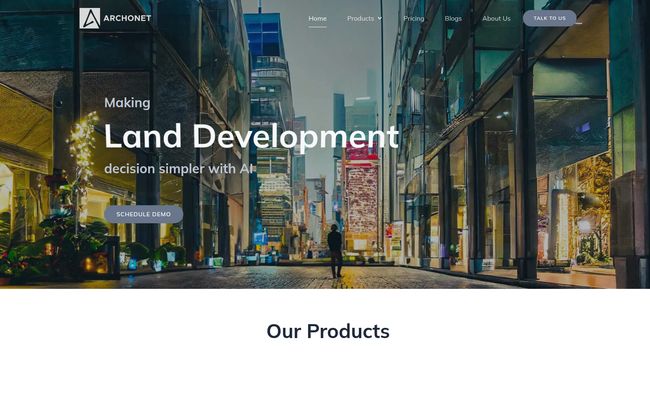
So when a tool comes along waving the “AI” flag and promising to make “Land Development decision simpler,” my ears perk up. Part of me is skeptical—we’ve all seen the AI hype train go off the rails. But another part, the part that’s seen the costly mistakes, gets genuinely curious. Today, I’m looking at a platform called Archonet that’s trying to do just that. Let's see if it's just smoke and mirrors or the real deal.
So, What Exactly is Archonet?
At its core, Archonet is an AI-first platform built for the big leagues of land development. Forget picking out paint colors for a spare bedroom; this is about evaluating massive land parcels and determining their absolute best use from a financial and regulatory standpoint. The entire idea is to swap out that 'gut feeling' for cold, hard, data-driven insights.
It’s not just one tool, but a suite of products designed to tackle different stages of the pre-construction puzzle. The big three they’re pushing are LandWise, FinWise, and PlanWise. Each one is a different lens to view a potential project through, aiming to give developers a 360-degree view before the first shovel ever hits teh ground. Honestly, the concept is something the industry has needed for a while.
Visit Archonet
A Closer Look at the Archonet Toolkit
Okay, let’s get into the nuts and bolts. A platform is only as good as its individual tools, right? Archonet splits its main offerings into two key products based on the features I'm seeing.
LandWise: Your Digital Surveying Crew
Think of LandWise as your initial reconnaissance tool. Its main job is to figure out the “highest development potential” of a piece of land. In the old days, this would mean weeks of work with architects and planners. LandWise aims to do this at speed. It looks at things like 3D scenario analysis, potential building configurations, and FSI (Floor Space Index) usage. It’s like having a team of experts on speed-dial, letting you war-game different development schemes to see what’s physically and legally possible before you get too emotionally or financially invested.
FinWise: The Financial Crystal Ball (That Actually Works)
If LandWise is about what you can build, FinWise is about whether you should. This is the heavy hitter. It seems to include all the features of LandWise but then adds a thick, critical layer of financial forecasting on top. We’re talking phasewise project cashflow, sales and marketing timelines, approval cost summaries, and even cost escalation impact. This is the stuff that keeps developers up at night. A miscalculation in your cashflow can sink a project faster than you can say “liquidity crisis.” Having a tool that models this out? That’s not just a convenience; it’s a massive risk-mitigation strategy.
The Features That Made Me Look Twice
I’ve seen a lot of software dashboards. Most are a mess. But when I looked at the feature breakdown for Archonet, a few things stood out as being genuinely useful. Here’s a quick rundown of what caught my eye.
| Feature | What It Means for a Developer |
|---|---|
| Scheme Comparison | Quickly compare building a residential tower vs. a mixed-use complex on the same plot. |
| 3D Scenario Analysis | Actually visualize different development options instead of just looking at numbers on a page. |
| Phasewise Project Cashflow (FinWise) | Understand your money needs not just for the whole project, but for each critical phase. Incredibly important for securing financing. |
| Cost Escalation Impact (FinWise) | Models what happens if steel or labor costs jump 10%. This moves planning from hopeful to realistic. |
| Sales & Marketing Timelines (FinWise) | Projects revenue based on absorption rates, helping to create a much more accurate financial picture. |
Let’s Talk Money: Archonet Pricing
Alright, the question on everyone's mind. How much does this AI-powered crystal ball cost? Let's just say it's not a subscription you put on your personal credit card. Archonet is priced for the enterprise clients it serves.
- 20 Land Parcels: ₹6,00,000
- 50 Land Parcels: ₹12,50,000
- 100 Land Parcels: ₹20,00,000
Seeing the price in Indian Rupees (₹) tells me they have a strong focus on the booming Indian real estate market, one of the most complex and fastest-growing in the world. And yes, those numbers might make you gulp. But you have to put it in perspective. A single bad land deal can cost a developer crores. The cost of this software, if it prevents even one major misstep on a large project, is practically a rounding error. It’s an investment in due diligence.
Who is Archonet Really For?
This is probably the most important point. This platform is not for the person flipping a single-family home. This is not for small-scale contractors. Archonet is a high-octane tool designed for a very specific user:
- Large-Scale Property Developers: Companies juggling multiple large projects who need to standardize their evaluation process.
- Real Estate Investment Funds (REITs): Firms that need to perform rapid, data-heavy due diligence on potential acquisitions.
- Urban Planning Consultants & Architectural Firms: Professionals who are tasked with creating feasibility reports for major commercial and residential developments.
If your daily job involves acronyms like FSI, RERA, and IRR, and your decisions are worth millions, then you're the person Archonet wants to talk to.
Final Thoughts: Is Archonet Worth the Hype?
I've gotta admit, I came in skeptical but I'm leaving impressed. Not because of the "AI" buzzword, but because Archonet seems to have built a practical solution for a very real, very expensive problem. The chaos of land development—with its tangled regulations, volatile market prices and complex financial models—is ripe for this kind of data-driven approach.
It’s a serious tool for serious players. It replaces a mountain of spreadsheets and a whole lot of guesswork with a streamlined, data-centric workflow. For the right company, this won't just be a helpful tool; it could become the central nervous system for their entire project acquisition and planning process. If you're in that league, scheduling a demo seems less like a sales call and more like essential research.
Frequently Asked Questions about Archonet
What is the main difference between LandWise and FinWise?
Think of it this way: LandWise tells you what is physically and legally possible to build on a piece of land. FinWise takes all that information and then builds a deep financial forecast on top of it, including cash flows, costs, and sales timelines, to tell you if it's a profitable venture.
Is Archonet suitable for small real estate investors?
In my opinion, probably not. The feature set and pricing structure are clearly aimed at large-scale developers and investment firms handling multi-million dollar projects. A smaller investor wouldn't be able to get the full value from its powerful, wide-ranging features.
Does Archonet help with legal and regulatory compliance?
It appears to be a major component. By incorporating factors like land ownership types, area under reservation, and development control regulations (like DCPR 2034 mentioned in their features), it helps evaluate a project's compliance from the very beginning, flagging potential red flags early.
How does the AI in Archonet actually work?
While they don't reveal their 'secret sauce', a platform like this typically uses AI and machine learning to process vast datasets. This would include municipal zoning laws, current market rates, construction material costs, historical sales data, and development regulations. It then runs simulations to generate the optimal outcomes presented in the reports.
Is the pricing a one-time fee?
The site says "billed at start of period," which suggests it's a subscription or term-based license (likely annual) rather than a one-time purchase. The price is for a set number of land parcel analyses within that period.
Conclusion
The world of real estate development is famously resistant to change, but you can't ignore gravity forever. The sheer complexity and risk involved in modern projects demand better tools. Platforms like Archonet are moving the industry away from the back-of-the-napkin and into the age of big data. It's a fascinating shift to watch, and for the developers who get on board, it could mean the difference between simply building projects and building a fortune.
Reference and Sources
- The Rise Of PropTech: How Technology Is Transforming The Real Estate Industry - Forbes
- Proptech in India: Embracing the change - JLL India